NE2605: Eastern White Pine as an Iconic North American Tree: Evolving Dynamics and Future Opportunities
(Multistate Research Project)
Status: Active
NE2605: Eastern White Pine as an Iconic North American Tree: Evolving Dynamics and Future Opportunities
Duration: 10/01/2026 to 09/30/2031
Administrative Advisor(s):
NIFA Reps:
Non-Technical Summary
Overall hypothesis or goal: Characterize the current stand development of eastern white pine (EWP) across its range and how that will likely influence future management and health of the species.
Specific objectives (Long-term underlined, short-term follow)
- Use FIA data to quantify the range of forest composition and growth of EWP where EWP has significant development. The initial analysis will be on data for Maine followed by data for other members of the Multi-state Project, first being New Hampshire, Vermont, and New York. Next will be analyses for North Carolina and Michigan. Finally, analyses will be completed for other states with significant volume of EWP including Massachusetts, Connecticut, Pennsylvania, Virginia, and Wisconsin.
- Assess the current status of EWP and future opportunities. The Project members will write a review paper that will provide the basis for guiding future research and management of the species.
- Revise silvicultural recommendations and forest management to improve EWP productivity, health, and economic return. The first recommendations will be developed for Maine after which recommendations will be developed for use in states of other Project members.
- Improve our understanding of EWP development and how to manage the species.
Statement of Issues and Justification
The need as indicated by stakeholders:
Eastern white pine is an iconic species for northeastern North America: Iconic species resonate with the public and can be used to engender broader public support for desired outcomes (Davies and Tippler 2024). Iconic species differ from indicator or keystone species because of the public connection; iconic species are not only biologically and ecologically important but also are part of a community’s culture.
Eastern white pine’s cultural connection to Indigenous Nations’ traditions (Mausel, Waupochick, and Pecore 2017) and the European settler’s development (D. R. Foster, Motzkin, and Slater 1998) is probably a partial result of its abundance due to regeneration across multiple environments, ability to grow larger and taller than any other species in the east, and wood that was suitable for lumber (Lancaster and Leak 1978; Wendel and Smith 1990).
White pine has enormous economic value throughout its range. Over the region, the net volume of white pine saw logs is over 186 billion board feet (USDA Forest Service, Forest Inventory and Analysis). With a typical market price of $100/1,000 bd ft, the potential value of standing white pine is $18.6 billion.
From an ecological perspective, white pine has significant impact on the eastern forest (Wendel and Smith 1990). White pine attains the largest dimensions of any eastern tree serving as a critical habitat for many species of wildlife that depend on emergent crowns and large snags and downed woody debris. In many parts of the range, EWP was the primary species that recolonized abandoned fields as farmers moved to more productive lands. This resulted in “old field pine”, stands dominated by EWP (Marshall 2009).
Silviculture and management of EWP has recommended developing stands that are dominated by EWP on sites where hardwoods are not aggressive (Lancaster and Leak 1978). However, after analyzing USDA Forest Service Forest Inventory and Analysis (FIA) plots in Maine (unpublished data), only about 5% of the plots were dominated by EWP (> 75% of the stems) (Maeve). Analysis of FIA data in Maine indicates that 15% of EWP commercial volume is in the spruce/fir (SF) type and another 31% is in the commercial hardwood (CH) types equaling the volume (44%) found in the EWP types. Additional analysis shows EWP volume growth is highest in the SF type and among the highest in the CH types resulting in EWP becoming the dominant species in stands with large diameters (12-18 in). About 30% of the regenerating EWP samplings occur in the SF, 53% in CH, and 19% in the pine type, a regeneration abundance that contradicts earlier impressions of eastern white pine becoming less dominant in mixed stands (Marshall 2009); the future of EWP in Maine will be in mixed species types.
For many decades, white pine health has been adversely affected by the non-native white pine blister rust (Cronartium ribicola) and the native white pine weevil (Pisodes strobi) (Costanza et al. 2018). More recently a stem canker pathogen, Caliciopsis pinea, and the pine bast scale, Matsucoccus macrocicatrices, have occurred separately or together in association with EWP decline, dieback, and mortality. Managing EWP stands can be effective in reducing risks and losses due to these fungal pathogens and insect pests (Livingston et al. 2019). A recent study (Noone-Price 2025) indicates that an alternative approach to reduce white pine weevil damage is to manage EWP in mixtures.
More information is needed on EWP dynamics in mixed species stands so that silvicultural and management guidelines can be developed to improve EWP regeneration, growth, health, and economic value.
Evolving dynamics of cultural, biological adaptations, and ecological interactions has made eastern white pine an iconic tree species for the forests of northeastern North America that is 1) culturally relevant, 2) covers a broad geography, 3) highly resilient and productive which 4) could be improved with effective management.
The importance of the work, and what the consequences are if it is not done.
Future supply of EWP is essential in states where there is commercial demand for the wood, and assurance of future availability will make the species more attractive for commercial investment in other states. Efforts are needed immediately to reduce the uncertainty about where and how to manage EWP across its range so that its health, growth, and value can be maintained or improved.
Although the multiple stress agents associated with EWP health issues make it a challenge to grow, strategies aimed at improving white pine health are readily available for stands dominated by EWP (Livingston et al. 2019). White pine has long been successfully regenerated using silvicultural methods, such as shelterwood and seed tree cuts, and responds very well to thinning, and recommended management strategies can reduce health risks (Lancaster and Leak 1978). However, as explained above, about half of the current volume of EWP occurs in stands mixed with other species, and it is not known if current recommendations on EWP health are appropriate for the mixed-species stands. By gaining a better understanding of how EWP is developing in the mixed species stand and how it can be managed along with associated species, we will be able to recommend silvicultural treatments that improve EWP growth and value and reduce the risk of white pine damage due to common stressors.
There are concerns about future development and availability of EWP and uncertainty on how the species will respond to a changing climate with some predicting reduced importance (L. Iverson, Prasad, and Matthews 2008; Prasad et al. 2020), and others are predicting stable habitat amounts (Yang et al. 2015; L. R. Iverson et al. 2019; U.S. Department of Agriculture, Forest Service. 2026). The uncertainty on the future range of EWP needs to be addressed to help with making future management decisions for the species.
The Hatch Act of 1887 funds investigations supporting rural economies by maximizing contribution by agriculture to the welfare of the consumer. As an iconic tree species, EWP is a model system where improved knowledge and understanding can significantly improve the species’ economic and ecological contributions to rural communities throughout most of the eastern US. As the following narrative will establish, EWP has proven economic value but is underutilized in much of it’s range. Our Multi-state effort will strengthen the confidence of land owners and industry that EWP will thrive in the future and be a source of economic prosperity to the region.
The technical feasibility of the research, the advantages of doing the work as a multistate effort.
The USDA Forest Service FIA program has provided a data resource from which the current status of EWP can be defined for states throughout its range. The length of data collection varies by state. Maine’s current FIA data set from the same sample plots begins in 1999, and the entire 3000+ plots were remeasured on a 5-year cycle such that most plots have been measured 5 times by 2023. Other states started to measure plots at a similar time but usually have a 7-year cycle for remeasuring plots. The raw data files can be downloaded from the FIA “Datamart” in comma delimited format such that it can easily provide input to R-studio and Excel for analysis.
Given the complexity and extent of EWP issues across a large range, it is unlikely that major advances will be accomplished by any single state’s group working in relative isolation; such advances require collaboration among groups working in parallel. Collectively, potential project members have an enormous amount of expertise in various aspects of tree management and health. Bringing members together in a structured and active arrangement would create a synergism in analyses and interpretation efforts, thereby increasing research efficiency and productivity, with the ultimate goal of improving EWP’s management and health throughout the region.
Currently, the potential project members include researchers and outreach professionals from Land Grant Universities in Maine, New Hampshire, Vermont, New York, Michigan, and North Carolina. Many of these participants work directly with stakeholders. Creating the multistate project will allow project members to:
- Review, synthesize, and share information from analyses of FIA data.
- Identify critical knowledge gaps that currently hamper efforts to improve EWP management.
- Avoid unnecessary duplication of research effort.
- Develop additional multi-institutional research proposals for national-level grants in order to bolster and build upon this initial work.
- Develop silvicultural prescriptions and other management recommendations to help mitigate potential white pine threats.
- Ensure that new findings are communicated with land managers.
What the likely impact will be from successfully completing the work.
Bringing together region-wide expertise on EWP issues will allow assessment of the species’ responses to a changing environment. The combination of land use changes and climate events may be initiating transformations in white pine’s responses to its environment that may dramatically alter the appropriate management prescriptions for the future. The proposed working group will initiate this assessment and develop a range-wide understanding of the future of EWP in the region’s forests. Finally, our goal of using this initial project to motivate an additional multi-institutional, national-level grant could lead to much broader impact than that outlined above.
Related, Current and Previous Work
Eastern white pine is an iconic species for northeastern North America
Iconic species resonate with the public and can be used to engender broader public support for desired outcomes (Davies and Tippler 2024). Iconic species differ from indicator or keystone species because of the public connection; iconic species are not only biologically and ecologically important but also are part of a community’s culture. Eastern white pine’s connection to Indigenous Nations’ traditions (Mausel, Waupochick, and Pecore 2017) and the European settler’s development (D. R. Foster, Motzkin, and Slater 1998) is probably a partial result of its regeneration across multiple environments and ability to grow larger and taller than any other species in the east (Lancaster and Leak 1978). Evolving dynamics of cultural, biological adaptations, and ecological interactions has made eastern white pine an iconic tree species for the forests of northeastern North America that is 1) culturally relevant, 2) covers a broad geography, 3) highly resilient and productive which 4) could be improved with effective management.
Historical Importance: Evolving Dynamics of an Iconic Tree
Cultural relevance
As stated by René H. Germain and colleagues, “the historical importance of eastern white pine (Pinus strobus) is legendary” (Germain, Nowak, and Wagner 2016). For European settlers, EWP was the “King’s pine”, reserved for use by the English Navy for its ships (Keating 2024). EWP is also considered the “Tree that built America” the species was the primary tree that European colonizers used for building settlements, and the transport of the large logs down the region’s rivers (Wilson 2005) was legendary, providing the basis for Paul Bunyan stories that began in Maine and spread westward (Croker 2009).
Eastern white pine has cultural significance to indigenous nations, and is well documented for the Menominee Tribe in Wisconsin (Mausel, Waupochick, and Pecore 2017). “The Tribe calls themselves ’Maeqtekuahkíhkíw Kew Kanaˆhwíhtahquaq,’ which translates to “The Forest Keepers,” and they recognize that the forest must remain for their unborn children’s children, a land ethic integral to Tribal identity.”
High resiliency and productivity across a broad range explained by eastern white pine’s biology and ecology
Eastern white pine has intermediate shade tolerance such that it can respond to a range of disturbances, such as growing after fires under the light shade of birch and aspen (Peterson and Squiers 1995) and taking advantage of gaps in forest cover due to windthrow or harvesting of large trees (Raymond et al. 2006). Periodic “cone crops” with prolific seed production help ensure establishment of the species across suitable habitats (Wendel and Smith 1990).
The species is fast growing compared to other associated species indicating that it can outcompete most other plants for resources (Wendel and Smith 1990). Growth of EWP does not slow down until after age 90 and will continue to add sawtimber volume at 100 years, allowing the species to become super-dominant in the canopy.
Range of EWP is determined by evapotranspiration: Precipitation must exceed evapotranspiration (Jacobson and Dieffenbacher-Krall 1995) which limits species to moister, cooler climates.
During the last glaciation the species was found in the current regions of North Carolina/Virginia western border, and as glaciers retreated, EWP spread up coast to its current range limit in Canada (Om P. Rajora, Andrew J. Eckert, John W. R. Zinck 2016). The species also spread inland and westward to the Great Lakes Region.
The species competes on a wide range of soils that are generally well drained (Wendel and Smith 1990). Hardwoods, such as the maples (Acer), are competitive on more nutrient-rich soils, but EWP is still part of mixture in hardwoods types (Eyre and Society of American Foresters 1980). The species becomes dominant on dryer soils, many times associated with red oak (Pine/Oak type). On drier, sandy soils, EWP is associated with hard pines (red pine, pitch pine).
As a consequence of EWP’s ability to compete on a wide range of soils and with many species, EWP’s was widely distributed in northern Maine prior to European colonization but at low densities, perhaps averaging about 1 large EWP per acre. However, it’s ability to develop into large trees across the range of conditions resulted in a massive amount of available timber for harvesting by European colonists, an amount that was three times more than the amount of standing EWP in the 2001 FIA inventory for that part of the state (Wilson 2005). The contrast in amount of EWP timber present in northern Maine over 200 years ago compared to the amount found today indicates the importance of understanding why these changes have occurred and if the past abundance of EWP is indicative of its future potential.
How EWP has maintained its presence across the landscape is dependent on its regeneration. which is associated with disturbance (Lancaster and Leak 1978; Wendel and Smith 1990). Regeneration of EWP will be successful if:
- Moderate light, > 20%, is available such as in:
- Gap openings associated with windthrow or harvesting.
- An overstory allowing light to filter through, e.g., as developing stands of aspen/birch (Peterson and Squiers 1995), red maple (R. W. Foster 1959), and red pine that can develop after stand replacing fires or other disturbances.
- Soils are disturbed resulting in minimal duff layer and vegetative competition (Lancaster and Leak 1978; Wendel and Smith 1990).
- A seed source is available (Kromholz, Webster, and Hyslop 2025).
In locations where fire is a rare disturbance such as in northern Maine (Lorimer 1977), EWP regenerated in hardwood stands typically as solitary trees that could out-grow the surrounding vegetation, or as small clumps of trees that could exclude regeneration of other species, or as released saplings when overstory trees died or blew over (Hibbs 1982). Outside of New England, fire likely helped maintain EWP in some forests, but in combination with logging of all seed trees and deer browsing, the disturbance could help reduce EWP abundance (Abrams 2001).
After regeneration, EWP stems must become established in the developing canopy. In hardwood stands, establishment of EWP and maintaining the stems in the canopy can be difficult in young ages when hardwood competitors can grow faster than EWP (Lancaster and Leak 1978; Wendel and Smith 1990; Smith and Ashton 1993; Leak 1995). However, once established in the canopy, EWP can maintain its position or emerge resulting in improved stand productivity ((R. W. Foster 1959; Hibbs 1982; Peterson and Squiers 1995; Raymond et al. 2006; Arseneault et al. 2011; Waskiewicz et al. 2013; Waterman et al. 2020; Clark and D’Amato 2021; Copenheaver, Frye, and Deane 2025; Kromholz, Webster, and Hyslop 2025). Interestingly, one study found EWP growth to increase when growing closer to aspen (Populus grandidentata and P. tremuloides) than other EWP (Peterson and Squiers 1995) indicating that a EWP tree competing with other EWP stems is more stressful than competing with stems of other species.
In softwood mixtures, EWP probably becomes established with eastern hemlock (Tsuga canadensis) and red spruce (Picea rubens) in manners similar to hardwood mixtures as described above (Orwig et al. 2022), with a few EWP trees emerging above the other species (Mary Ann Fajvan and Seymour 1993) which can increase overall stand volume (M. A. Fajvan and Seymour 1999). In addition, spruce budworm (Choristoneura fumiferana) defoliation can increase EWP regeneration and growth when growing with spruce and fir (Abies balsamae) (Lavoie et al. 2026).
Another type of EWP stand development became present after European colonizatonwhen agricultural fields within EWP’s range were abandoned in the 1800’s and early 1900’s. EWP could compete with the grasses better than other tree species (D. R. Foster, Motzkin, and Slater 1998) such that many old fields regenerated to almost pure stands of EWP. When these stands mature, they are frequently replaced by mixtures of other species.
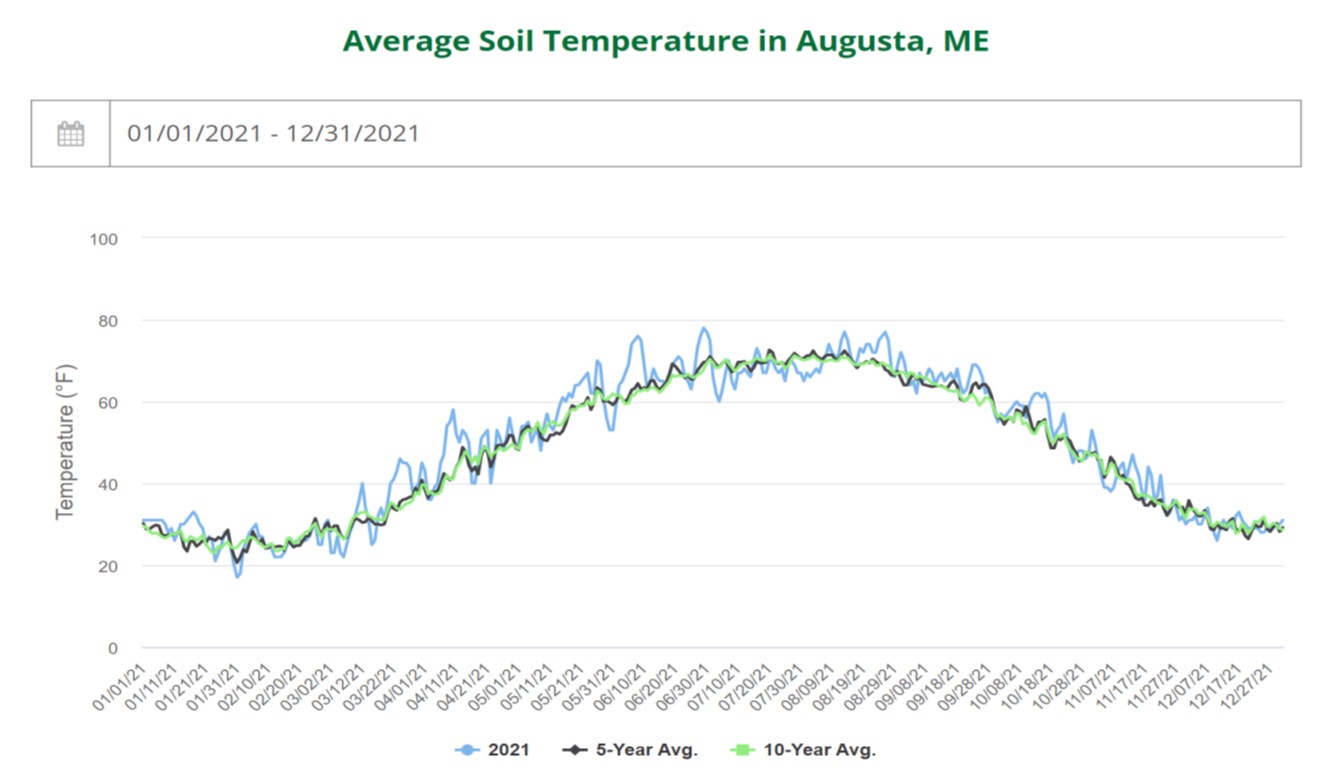
The fastest growth of EWP is found in the southern part of its range. In western North Carolina and adjacent parts of Virginia, EWP reaches merchantable age in 25-50 years (Balmer and Williston 1983) compared to 50-75 years in the Northeast (New York, New England, eastern Canada) (Lancaster and Leak 1978). Volume growth in southern Appalachia (Balmer and Williston 1983) is about 7,000 cubic feet per acre (site index 60, age 35) which is nearly twice the amount found in the Northeast (Lancaster and Leak 1978) at 4,000 cubic feet per acre (site index 60, age 40). Growing season conditions are similar between the two regions (Table 1) but winters are warmer in the south such that roots likely remain active for two additional months each year when compared to the Northeast (Figure 1). With EWP habitat area being stable in the future (L. R. Iverson et al. 2019), there is a potential that EWP productivity will increase as winters become warmer.
|
Table 1. Climate data for Maine and the Blue Ridge Plateau (VA and NC, National Weather Service data). |
||||||||||||||||||||||||||||
|
|
Figure 1. Soil temperature estimates or (a.) Augusta, ME, and (b.) Spruce Pine, NC. Data from Open-meteo.com Weather API. Zenodo. https://doi.org/10.5281/ZENODO.7970649 |
|
a. |
|
b. |
Health Issues
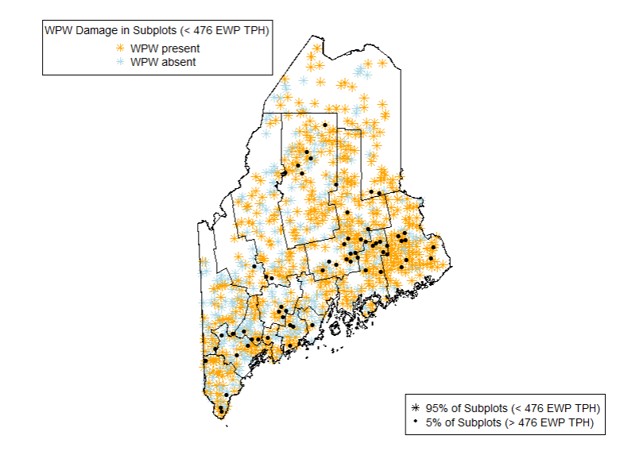
Eastern white pine has experienced a number of health issues that can affect its regeneration, establishment and growth (Costanza et al. 2018). White pine blister rust pathogen, Cronartium ribicola, was introduced from Europe on EWP seedlings in the early 1900’s, and the fungus is currently found throughout the range but is not considered a limiting factor in EWP regeneration and growth. White pine weevil (Pisodes strobi) kills the terminal leaders of developing white pine resulting in deformed stems and loss of economic value. Seventy percent of 1,757 FIA subplots across Maine with at least one EWP had observed white pine weevil damage (Noone-Price 2025). However, if white pine composition was over 75%, all plots had damage (Figure 2). There was a slight spatial association between white pine weevil damage and water surplus index with damage decreasing as the water surplus index increases (Noone-Price 2025).
|
Figure 2. White pine weevil (WPW) damage across Maine U.S. for subplots with high or low values of EWP TPH. Subplots with > 476 EWP TPH (192 EWP trees per acre (n = 75)) are considered high. Subplots with < 476 EWP TPH (n = 1,682) are considered low. Low EWP TPH values represent the 95th percentile of subplots (Noone-Price 2025). |
In contrast to the northern part if EWP’s range, white pine weevil causes minor damage in the southern part of its range(Katovich and Mielke 1993), possibly associated with shallow duff layer (Noone-Price 2025).
White pine declines, that is, prolonged periods of reduced growth followed associated with diebacks and mortality, occur periodically throughout its range(Costanza et al. 2018). In Maine, a drought incited mortality in EWP stands that were overstocked and on sites with shallow roots(Livingston and Kenefic 2018). Additional stressors associated with EWP declines include Caliciopsis pinea canker and pine bast scale (Matsucoccus), and needle damage associated with infections by four pathogenic fungi (Costanza et al. 2018).
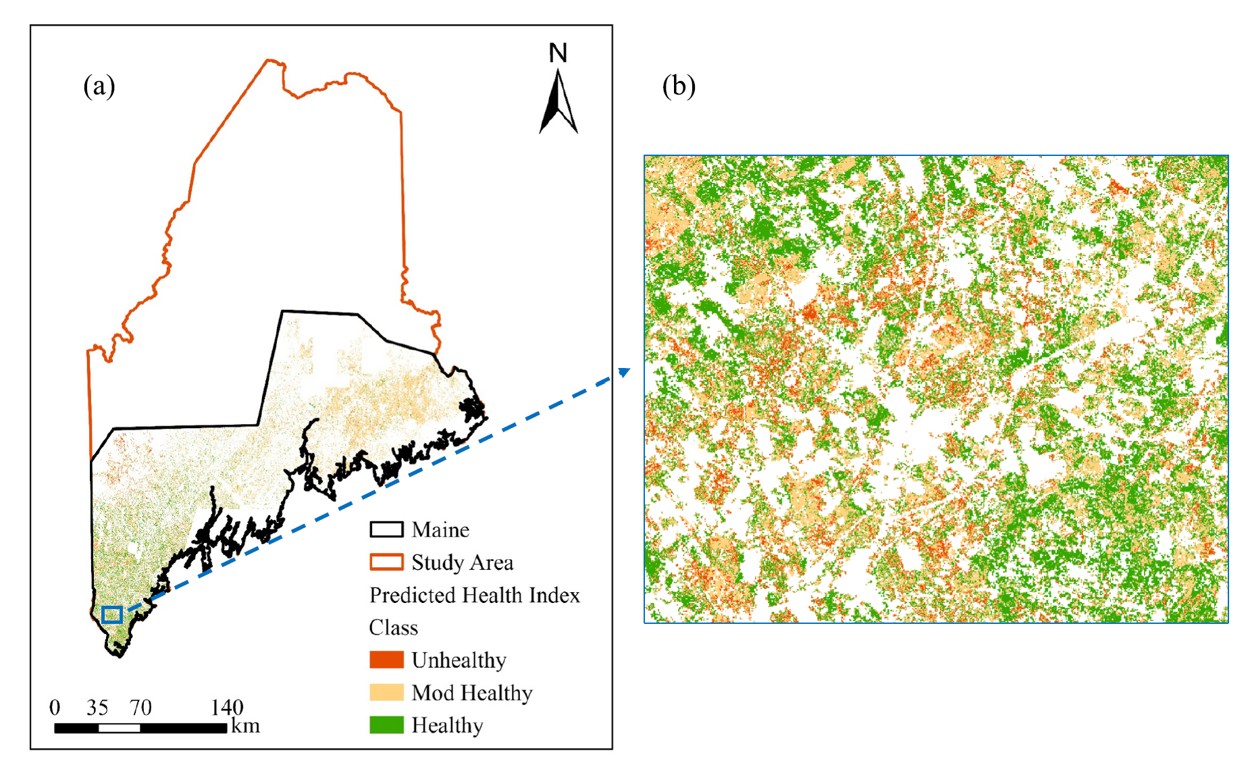
Use of remote sensing techniques can be used to measure white pine health (Meneghini et al. 2022; Das et al. 2024). Microwave (Sentinel-1) and optical (Sentinel-2) remote sensing data were used to predict leaf area index and live crown ratio. The predictions were integrated with canopy height and stand density to develop a novel health index map for EWP. The resulting health index map successfully delineated patches representing various health categories (Figure 3). The map can indicate trees that are suffering from stresses such as white pine needle damage (Das et al. 2024).
|
Figure 3. Eastern white pine (EWP) stand health index map for (a) southern Maine, USA, and (b) highlighted over an area. |
Forest management can improve EWP resilience, productivity, and wood quality, but the species is mostly underutilized.
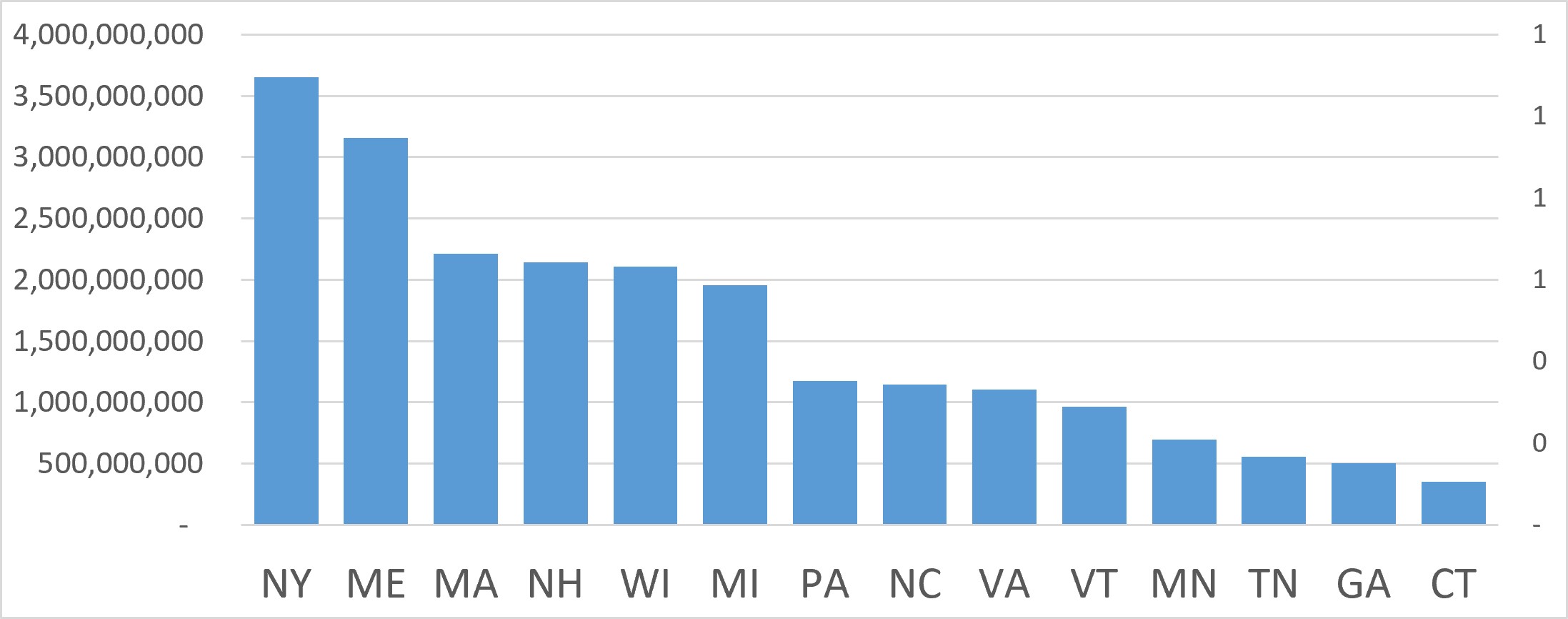
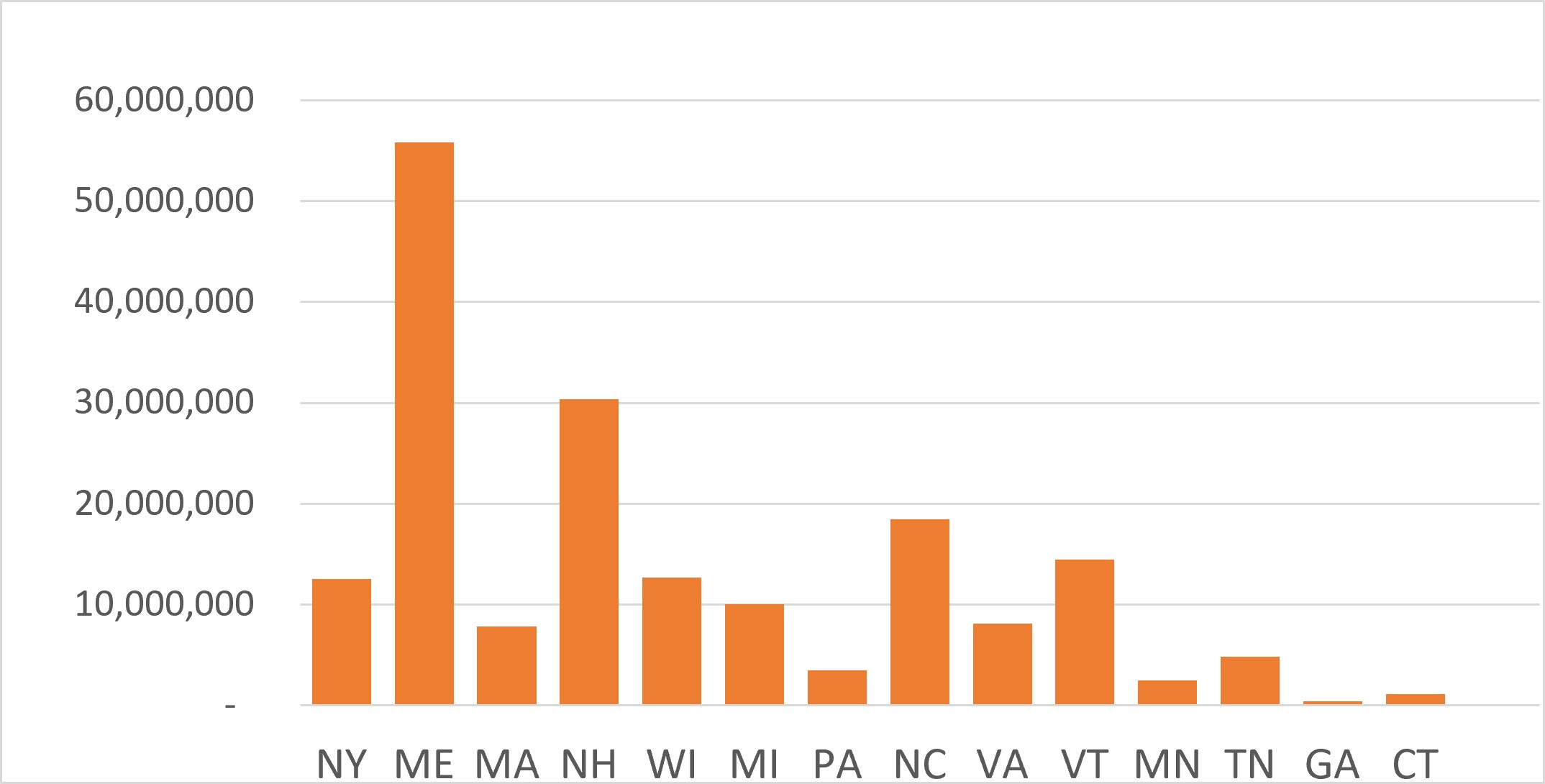
The states with the most volume of EWP are in Figure 4. Total volumes, however, do not necessarily equate to the level of management and degree of utilization. For example, North Carolina has the third highest harvest volume of EWP but has the eighth highest total volume (Figures 4 and 5). Across the New England states of ME, NH and VT the EWP resource is intensively harvested and utilized. These states are harvesting approximately 1.5% of the standing volume on an annual basis, resulting in growth to harvest ratios of less than 2:1 (Figure 5). This indicates an equilibrium between harvesting and growth which allows for a sustained yield of forest products from EWP timberlands.
Most of the remaining states across EWP’s range are harvesting less than one percent of the standing volume; the species is underutilized. A case in point is NY, the state with the most EWP of any state in the country has a growth to harvest ratio of 4:1. Wood quality is a problem (Germain, Nowak, and Wagner 2016). As characterized by the USFS, approximately three quarters of the stumpage is classified as low grade (#3 or lower). These stems will generate primarily low-grade logs with a value of roughly $150/mbf which in turn produce low-grade lumber such as standard and industrial grade. Sawmills avoid processing low grade EWP logs because of the poor grade yield. The balance (25%) of the NY EWP stumpage is characterized by stems with a grade 1 or 2 butt log with a value of $200 - $400/mbf which provides a better opportunity to generate better lumber grades of premium, finish and select. But even high quality EWP stems can produce a significant amount of standard and industrial grade lumber due to the high frequency of black knots in the upper logs. Intensive management using low-density thinning at an early age can increase crown ratios and replace degrading black knots with red knots, significantly improving lumber grade yields(Germain, Nowak, and Wagner 2016). There is substantial, unrealized potential for increasing management and utilization of EWP.
|
Figure 4. Net merchantable bole volume of live trees (at least 5 inches d.b.h./d.r.c.), in cubic feet, on forest land. |
|
Figure 5. Average annual harvest removals of sound bole volume of trees (at least 5 inches d.b.h./d.r.c.), in cubic feet, on forest land. |
Managing tree densities can minimize risks to white pine health and value, and pruning will increase wood quality. Shelterwood cuts can establish high densities of sapling and reduce damage associated with white pine weevil. Afterwards, thinning stands to low densities avoids competition stress and reduces decline risk (Livingston et al. 2019).
Managing EWP in stand mixtures also offers future opportunities. In addition to good productivity as described earlier, wood quality could be improved. Incidence of white pine weevil damage is reduced in Maine in stand mixtures. Weevil damage incidence is 100% of the locations with high EWP densities (> 192 EWP/ac) compared to 70% incidence in locations with lower EWP densities (Noone-Price 2025). Stem quality could also be improved on emergent EWP due to possible self-pruning of branches that are within the canopy.
Eastern white pine plantations are frequently used in North Carolina and Virginia where white pine weevil damage is low. Old fields or harvested sites are prepared for planting, sometimes with prescribed fire, and seedlings are planted at wide spacing, such as 10 ft to 12 ft spacing and harvested after about 50 years (Balmer and Williston 1983).
Menominee Tribal Nation in Wisconsin emphasizes sawlog quality and quantity. Eastern white pine is the primary commercial species, but structural and compositional diversity are part of management plans so that trees are grown to old age and large diameters using uneven-aged management or extended rotations in even-aged management.
Lack of markets for white pine pulpwood limits management options in all regions for removing small diameter stems to reduce stand densities.
The future of eastern white pine as an iconic species
Forest Management and EWP Development
Forest management objectives for EWP will determine its future development across its range. Field abandonment will no longer be a major source of developing stands dominated by EWP. Therefore, future stands with high amount of EWP will depend on plantations and shelterwood management. As indicated by the pre-colonial distribution of EWP, lack of silvicultural intervention will likely result in EWP developing in low densities among other species across a broad range of forests. These stands have fewer EWP per acre, but the area is extensive and a future source of EWP timber. Therefore, forest land managers across much of the EWP range will have the opportunity to manage for EWP over a range of conditions. There are good guidelines for managing EWP dominated stands (Lancaster and Leak 1978, Balmer and Williston 1983, Livingston et al. 2019). For the mixed species stands, there are silvicultural recommendations if the manager wants to increase the presence and development of EWP in hardwoods (Lancaster and Leak 1978). Silvicultural recommendations for EWP growing in conifer mixtures, such as the spruce/fir types in Maine, are lacking, but one study suggests emulating spruce budworm outbreaks by using shelterwood ((Lavoie et al. 2026). In mixed stands, EWP is less likely to be damaged by white pine weevil which should result in better stem quality(Noone-Price 2025).
In general, EWP can be regenerated across different forest types if seed trees are present, partial light (> 20%) is available, and the soil is scarified. Increasing the composition and growth of EWP can be accomplished by removing competitors through managing stand densities (Livingston et al. 2019) and using crop tree management (Raymond et al. 2003) and low densities (R. S. Seymour and Smith 1987; Leak and Lamson 1999; R. S. Seymour 2007).
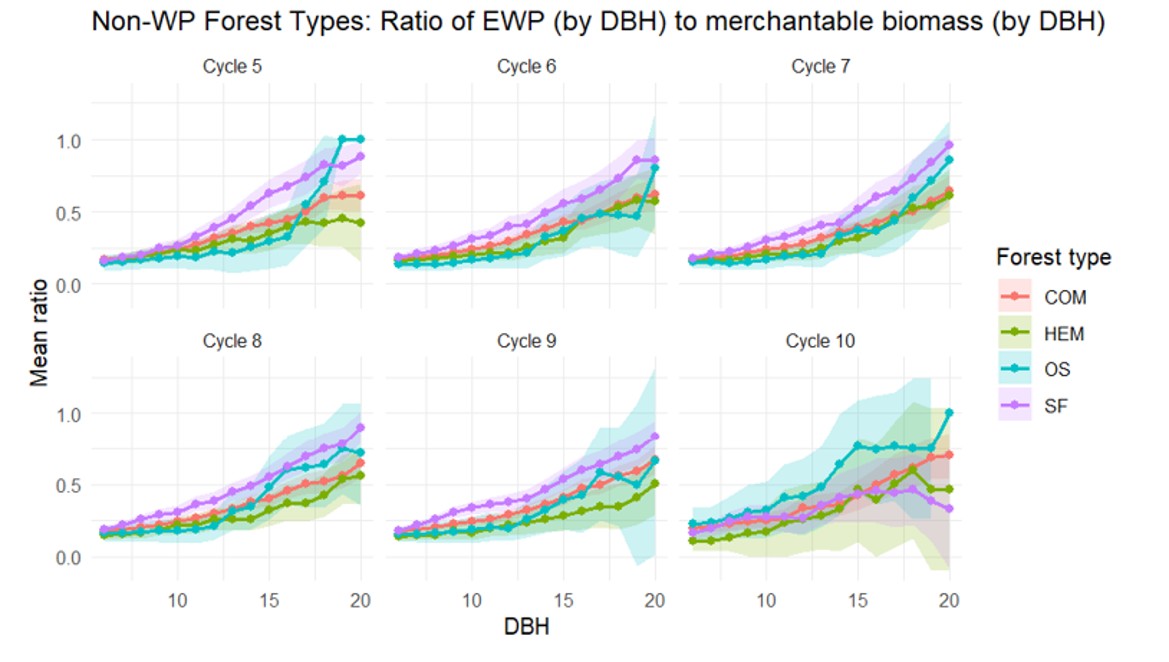
A more detailed analysis of FIA EWP data has begun in Maine across 25 years of FIA data collection in the state (Zhao 2025), and the data confirms EWP’s ability to develop across a wide range of conditions and can compete well in many forest types. The data was organized into cycles, a 5-year period during which all inventory plots were measured. The number of plots that had consecutive measurements at 5-year intervals from 1999 to 2023, were less than 140 years old, and contained >= 90% tree coverage totaled 2,980 out of 3,236 plots. The plots were divided into 6 forest types based on the majority of stand composition based on biomass measurements from 2002-2006; white pine (WP), spruce-fir (SF), other softwoods (OS, mostly wet sites), commercial hardwoods (COM), and other hardwoods (OH, mostly wet sites). About half of the EWP stems used in the analysis are in the WP forest type, nearly a third is in the COM type, about 12% in is SF, and 4% in OS. EWP rarely occurs on the OH type and is not included in the analyses. In the SF type, EWP biomass begins to exceed SF biomass when stems are larger than 12 inches DBH (Figure 6). Even in the COM type, EWP biomass begins to exceed the hardwood biomass at 18 inches DBH (Figure 6). Even though EWP on the mixed-species sites is only about 2 to 4% of the stems used in the analysis, EWP can dominate the larger diameter classes.
|
Figure 6. EWP’s relative importance increases with DBH across all non-WP types, indicating that EWP tends to occupy (and persist to) larger size classes. SF shows the earliest and most persistent EWP dominance, while HEM requires the largest sizes for EWP to become dominant. COM and OS are intermediate but differ at small-mid diameters (COM higher than OS). Forest types based on biomass in 2002-2006: COM = commercial hardwoods, HEM = hemlock, OS = other softwoods, SF = spruce/fir. From Cycle 5 = 1999-2003 measurement, Cycle 6 = 2004-2008, Cycle 7 = 2009-2013, Cycle 8 = 2014-2018, Cycle 9=2019-2023, and Cycle 10 = 2024. (Zhao 2025) |
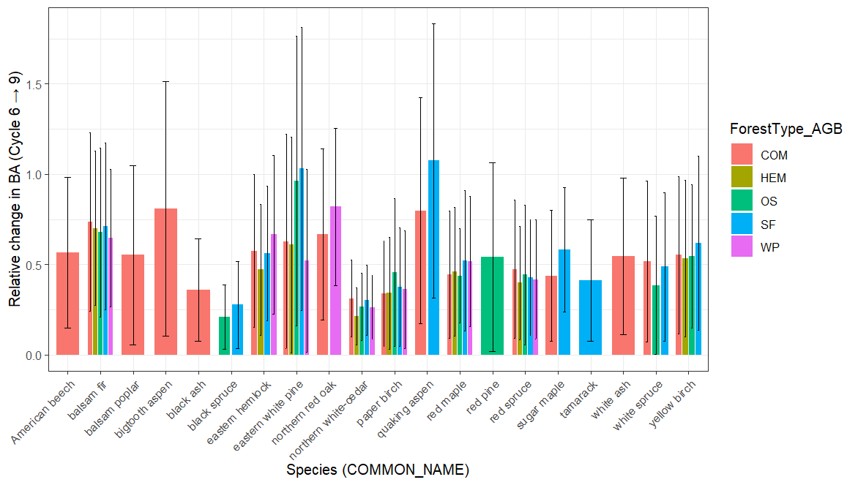
Zhao and Livingston (unpublished data) have made preliminary analysis of FIA data to quantify the growth of trees over 5 inventory cycles and compared the trees samples during FIA inventory cycle 5 (1999-2003) with inventory cycle 9 (2019-2023). Basal area (BA) increase per tree is quantified by calculating a relative basal area (Figure 7); (BACycle 9--BACycle5)/BACycle5 such that a double in BA results in a Relative BA =1. The relative basal area increments for EWP had the highest value for conifers in the OS, SF, and WP types, and was among the higher values in the COM type (Figure 7). One major surprise is that EWP basal area increment was the highest in OS and SF types, almost 30% more than in the WP type (Figure 7). Relative BA increment is associated with larger diameters. The DBH of EWP pine was about 13 inches with diameters about a half inch larger in softwood types and about 1.5 inches smaller in the hardwood COM type. These diameter averages are the largest for the species in the softwood stands and among the highest in the COM stands.
|
Figure 7. Relative change in basal area (BA) as calculated using (BACycle 9--BACycle5)/BACycle5 such that a double in BA results in a Relative BA =1. Measurements are based individual tree changes over 20 years as completed in FIA Cycle 5 (1999-2003) to Cycle 9 (2019-2013). Forest types based on biomass in 2002-2006: COM = commercial hardwoods, HEM = hemlock, OS = other softwoods, SF = spruce/fir. From Cycle 5 = 1999-2003 measurement, Cycle 6 = 2004-2008, Cycle 7 = 2009-2013, Cycle 8 = 2014-2018, Cycle 9=2019-2023, and Cycle 10 = 2024. |
|
|
EWP growth in mixed stands is competitive or exceeds the growth of other species. As a plus, there is less weevil damage in the mixed-species stands (Noone-Price 2025). The status of other EWP pests in the mixed-species stands is not known.
Seymour (R. Seymour 2021) summarized the occurrence of 2 in DBH saplings in the FIA dataset and found 18% in the pine types, 30% in the spruce-fir types, and 52% in the hardwood types.
Given the above, EWP will remain present and productive in the Maine forest. A more detailed analysis of EWP status is needed in other states to understand which trends in Maine can be documented elsewhere, and if states are experiencing different trends in EWP development.
In Maine, future development of the majority of the EWP resource will occur outside of stands dominated by EWP. There is a need to understand the economic, ecological, and silvicultural implications of EWP in mixed-species stands.
Future Conditions
In addition, future conditions may be favoring EWP in Maine. EWP in the southern Appalachians has nearly twice the growth rate as in the northeastern US (Lancaster and Leak 1978; Balmer and Williston 1983). When looking at climate data, summer conditions are similar between the two regions (Table 1), but winters are warmer, such that soil activity at > 40 F is probably 2 months longer in the southern region (Figure 1). Therefore, warmer winters could favor EWP growth in the future. Also, the warmer winter temperatures allow more decomposition of the litter layer, a factor associated with less white pine weevil damage (Noone-Price 2025).
USFS Tree Atlas (L. R. Iverson et al. 2019) estimates that eastern white pine will maintain its current importance in the forest by 2100. Increased water use efficiency due to higher CO2 levels could also help eastern white pine remain competitive in parts of its current range (Handler 2014). “Common garden” studies indicate that the population in southern Appalachia will grow faster under warmer conditions compared to northern populations (Chhin et al. 2018).
Eastern white pine is likely to remain available for economic use with the potential to expand into new markets where it is under-utilized.
Future challenges:
The above information provided the basis for future questions requiring additional assessment of current information and research to provide needed information. Such questions include:
- Most future white pine will be in mixed stands; how should they be managed?
- What is likelihood of white pine regeneration with current and future management practices in mixed-species stands?
- Is regeneration shifting from where it is currently present?
- How well will white pine compete in mixed-species stands? Can EWP in mixed-species stands be managed to make them more valuable economically and ecologically?
- What are good options for growing EWP dominated stands?
- Is shelterwood economically feasible given the need to manage stem densities without markets for small diameter stems?
- Can seed sources from southern Appalachia produce trees with higher volume production in northern areas?
- Will EWP plantations become feasible if tree improvement and climate changes reduce WPW damage?
- Can remote sensing be used to quantify geographic distribution of stresses from competition, drought, and pests (e.g., Figures 2 and 3) and used to identify potential strategies to mitigate adverse impacts on EWP?
- Can new markets for young EWPbe developed, such as pine-tipping, to help improve EWP management and utilization?
- How can EWP saw-log trees be better utilized across its range?
Related work from CRIS projects
There are no active EWP projects in the CRIS database except for NE 2101 which is ending.
A couple of projects do establish a communications network for developing and improving forest management across states.
S1091: Forest Health and Resilience
Facilitate further integration of the forest health programs at land grant Universities, and provide science-based solutions to land managers and regulators.
WCC1003: Coordination of Western Regional Extension Forestry Activities
Coordinates Extension Foresters in the Western states to enable more efficient and effective use of limited resources available for educating about natural resource management in a collaborative manner.
Objectives
-
1. Use FIA data to quantify the range of forest composition and growth of EWP where EWP has significant development.
Comments: The analysis will be completed for each state represented in the Multi-state project. -
Assess the current status of EWP and future opportunities.
Comments: The Project members will write a review paper that will provide the basis for guiding future research and management of the species. -
3. Revise silvicultural recommendations and forest management to improve EWP productivity, health, and economic return.
Comments: The first recommendations will be developed for Maine after which they will be modified for use in states of other Project members. -
4. Improve our understanding of EWP development and how to manage the species.
Comments: Outputs from the first three objectives will provide the basis and justification for developing strategies, such as research proposals, to advance our knowledge on EWP.
Methods
- Use FIA data to quantify the range of forest composition and growth of EWP where EWP has significant development. The initial analysis will be completed using data for Maine followed by data for other members of the Multi-state Project, first being New England (New Hampshire, Vermont, Massachusetts, Connecticut, Rhode Island) and New York, Next will be analyses for North Carolina and Michigan. Finally, analyses will be completed for other states with significant volume of EWP including Pennsylvania, Virginia, and Wisconsin. Starting with the first annual meeting and continuing with additional online meetings as needed, the Multi-state members will develop a set of parameters for use in the analysis including forest type definitions, relative measures to compare species over time such as DBH, BA, biomass volume, cut volume, and relative basal area. Figures 4-7 provide examples. Livingston at the University of Maine will lead the analysis effort, and other committee members will have the opportunity to review results and recommend additional analyses at annual meetings or on a more frequent schedule if desired.
- Assess the current status of EWP and future opportunities. First, the Project members will write a review paper entitled, “Eastern White Pine as an Iconic North American Tree: Evolving Dynamics and Future Opportunities”. The objective of the manuscript is to define the current status of EWP knowledge, indicate how the species will likely develop in the next 100 years, and explore future challenges, opportunities, and research needs to better manage the species. At the first annual meeting, members of the Multi-state project will review a manuscript draft by Dr. Livingston and decide on who will focus on a topic for additional development. Manuscript drafts will be reviewed by all project members until a manuscript is submitted to a national journal, such as the Journal of Forestry. Online tools (Google Docs, Paperpile) to facilitate collaborative work on a manuscript. If the length of the manuscript is a concern, project members can recommend development of a manuscript series to address the important issues.
- Revise silvicultural recommendations and forest management to improve EWP productivity, health, and economic return. Outputs from Objectives 1 and 2 will be used to develop silvicultural and management guidelines for EWP. The Project members will need to decide if a single manual is appropriate or if separate manuals are needed for different regions, such as New England, New York, Lake State, and Southern Appalachians.
- Submit research proposals to improve our understanding of EWP development and how to manage the species. Results from Objectives 1 and 2 will be used to develop research proposals to address the key needs identified in
Measurement of Progress and Results
Outputs
- Standardization of FIA analysis among states (Objectives 1) Comments: - Forest types - Measures of growth - Relative measures to compare species
- Publication on the future of EWP (Objective 2).
- Silvicultural and management recommendations (Objective 3). Comments: - Presented at professional meetings - Documents available for download
- Research proposals submitted.
Outcomes or Projected Impacts
- Roles of white pine health issues in the forest ecosystem are better understood and help to explain forest responses to land use changes and climate changes. From this understanding, effective management recommendations can be made. Probable impacts are: 1) Review manuscript is accepted for publication in a national journal. New perspectives on EWP management become available to a national audience. 2) New silvicultural and management guidelines become available for use by landowners and forest managers. 3) Research proposals are funded to advance knowledge on EWP growth, health, and management.
Milestones
(1):- Basis for FIA analysis and review paper are agreed to by Project members - Draft of review paper is submitted - FIA analysis completed for New England(2):- Review paper is published - Proposal developed for a major program, such as USDA’s Sustainable Agriculture Systems. - FIA analysis completed for New York, North Carolina, and Michigan. - Silvicultural and management recommendations developed for New England.
(3):- FIA analysis completed for Virginia, Pennsylvania, and Wisconsin - Silvicultural and management recommendation developed for New York - Proposal development continues until funding is achieved.
(4):- Silvicultural and management recommendations developed for southern Appalachia (NC, VA), Pennsylvania, and Lake States (Michigan, Wisconsin). - Proposal development continues until funding is achieved.
(5):- Proposal development continues until funding is achieved.
Projected Participation
View Participation Form/Appendix E: ParticipationOutreach Plan
The goal of the outreach plan is to provide a two-way communication process so that new information can be shared with external partners and the external partners can share their needs with the research team.
Information developed in the project will be shared with the Northeast Extension Forest Resources Educator Council (NEFREC) and the Northeast Silviculture Institute with the primary contact being Steven Roberge, Extension Forestry Specialist & Professor at the University of New Hampshire Cooperative Extension.
The format for offerings by the Northeast Silviculture Institute for Foresters involves planning a field workshop event at which videos can be made for future use (see https://extension.unh.edu/northeast-silviculture-institute-foresters/about). Each of the workshops includes at least:
- Silvics of individual species & Stand Dynamics including land use history
- Silvicultural Systems and Practices including growth, yield, quality and regeneration
- Economics, utilization & markets
- Forest Health
- Wildlife Considerations specific to forest type
- Soils
- Site Quality and Productivity
- Sample prescriptions
- Legal, landowner objectives & carbon considerations
- Field Trip into forest type
For EWP, the workshop will need to deal with EWP’s wide range of stand development, such as EWP dominated stands (plantations, old fields), EWP in hardwood mixtures, and EWP in conifer mixtures.
A workshop on EWP management in mixed species stands is being developed in cooperation with the University of Maine’s Cooperative Forest Research Unit which depends on financial support of organizations that own and/or manage forested land in the state. Developing the workshop includes interviewing external partners on their existing plans for managing EWP in mixed stands and what questions and needs they have about the management. The first workshop will be given by June 2027, and the workshop will form the basis of a proposal to add EWP management in mixed species stands as an update to the Northeast Silviculture Institute program.
Project personal will continually provide project information updates at presentations at professional meetings such as the New England Society of American Foresters annual meetings.
A paper that summarizes findings of the FIA analyses will be submitted for publication by the end of 2026. A full review paper on EWP as an iconic species will be submitted for publication in the Journal of Forestry by the end of 2027.
Organization/Governance
The project will use the standard form of governance. Participating institutions will send at least one representative to an annual meeting, and meeting attendees will be considered the Technical Committee. The Technical Committee will elect officers of chair, chair-elect, and secretary at the annual meeting. The chair-elect normally succeeds to chair the following year. Each officer is eligible for re-election. Sub-committees focused on particular objectives. Meetings will confer as needed by teleconference or in-person to plan and coordinate details of the multi-state project.
Literature Cited
Abrams, Marc D. 2001. “Eastern White Pine Versatility in the Presettlement Forest.” Bioscience 51 (11): 967.
Arseneault, Justin E., Mike R. Saunders, Robert S. Seymour, and Robert G. Wagner. 2011. “First Decadal Response to Treatment in a Disturbance-Based Silviculture Experiment in Maine.” Forest Ecology and Management 262 (3): 404–12.
Balmer, William E., and Hamlin L. Williston. 1983. Managing Eastern White Pine in the Southeast. Forestry Report R*-FR 1. U.S. Department of Agriculture, Forest Service, Southern Region.
Chhin, Sophan, Ronald S. Zalesny Jr, William C. Parker, and John Brissette. 2018. “Dendroclimatic Analysis of White Pine (Pinus Strobus L.) Using Long-Term Provenance Test Sites across Eastern North America.” Forest Ecosystems 5 (March). https://doi.org/10.1186/s40663-018-0136-0.
Clark, Peter W., and Anthony W. D’Amato. 2021. “Long-Term Development of Transition Hardwood and Pinus Strobus - Quercus Mixedwood Forests with Implications for Future Adaptation and Mitigation Potential.” Forest Ecology and Management 501 (119654): 119654.
Copenheaver, Carolyn A., Ethan A. Frye, and Olivia K. Deane. 2025. “Composition and Disturbance History of a Forest Fragment in Virginia, USA.” Tree-Ring Research 81 (2): 72–80.
Costanza, Kara K. L., Thomas D. Whitney, Cameron D. McIntire, William H. Livingston, and Kamal J. K. Gandhi. 2018. “A Synthesis of Emerging Health Issues of Eastern White Pine (Pinus Strobus) in Eastern North America.” Forest Ecology and Management 423: 3–17.
Croker, M. Ryan. 2009. “The Life and Origins of Paul Bunyan: Volume 1.” ProQuest Dissertations & Theses. https://maine.primo.exlibrisgroup.com/discovery/fulldisplay?docid=cdi_proquest_journals_2501896551&context=PC&vid=01MAINE_INST:UM&lang=en&search_scope=MyInst_and_CI&adaptor=Primo%20Central&tab=Everything&query=any,contains,paul%20bunyan%20in%20maine&offset=0.
Das, Pulakesh, Parinaz Rahimzadeh-Bajgiran, William Livingston, Cameron D. McIntire, and Aaron Bergdahl. 2024. “Modeling Forest Canopy Structure and Developing a Stand Health Index Using Satellite Remote Sensing.” Ecological Informatics 84 (December). https://doi.org/10.1016/j.ecoinf.2024.102864.
Davies, Peter J., and Carl Tippler. 2024. “A Framework for Using Community Determined Iconic Species to Advance Socio-Ecology Connections and Promote Nature-Based Solutions.” Nature-Based Solutions 6 (100160): 100160.
Eyre, F. H., and Society of American Foresters. 1980. Forest Cover Types of the United States and Canada. Vi, 148 pages ; 28 cm. Washington, D.C. (5400 Grosvenor Lane, Washington, D.C. 20014): Society of American Foresters.
Fajvan, M. A., and R. S. Seymour. 1999. “Influence of White Pine on Structure and Yields of Mixed Northern Conifer Forests.” Journal of Sustainable Forestry 8 (1): 61–74.
Fajvan, Mary Ann, and Robert S. Seymour. 1993. “Canopy Stratification, Age Structure, and Development of Multicohort Stands of Eastern White Pine, Eastern Hemlock, and Red Spruce.” Canadian Journal of Forest Research 23 (9): 1799–1809.
Foster, David R., Glenn Motzkin, and Benjamin Slater. 1998. “Land-Use History as Long-Term Broad-Scale Disturbance: Regional Forest Dynamics in Central New England.” Ecosystems (New York, N.Y.) 1 (1): 96–119.
Foster, Ralph W. 1959. “Relation between Site Indexes of Eastern White Pine and Red Maple.” Forest Science 5 (3): 279–91.
Germain, René H., Chris A. Nowak, and John E. Wagner. 2016. “The Tree That Built America—Not Making the Grade.” Journal of Forestry 114: 552-561-552–61.
Handler, Stephen Dwight. 2014. Michigan Forest Ecosystem Vulnerability Assessment and Synthesis a Report from the Northwoods Climate Change Response Framework Project. 1 online resource (229 pages) : color illustrations, color maps. General Technical Report NRS 129. Newtown Square, PA: U.S. Dept. of Agriculture, Forest Service, Northern Research Station.
Hibbs, David E. 1982. “White Pine in the Transition Hardwood Forest.” Canadian Journal of Botany 60 (10): 2046–53.
Iverson, Louis, Anantha Prasad, and Stephen Matthews. 2008. “Modeling Potential Climate Change Impacts on the Trees of the Northeastern United States.” Mitigation and Adaptation Strategies for Global Change 13 (5–6): 487–516.
Iverson, Louis R., Matthew P. Peters, Anantha M. Prasad, and Stephen N. Matthews. 2019. “Analysis of Climate Change Impacts on Tree Species of the Eastern US: Results of DISTRIB-II Modeling.” Forests 10 (4): 302.
Jacobson, George L., and Ann Dieffenbacher-Krall. 1995. “White Pine and Climate Change: Insights from the Past.” Journal of Forestry 93 (7): 39–42.
Katovich, S., and M. Mielke. 1993. How to Manage Eastern White Pine to Minimize Damage from Blister Rust and White Pine Weevil. USDA-FS, NA-FR-01-93.
Keating, Steve. 2024. “White Pines and the King’s Broad Arrow.” In Conifers of the New England–Acadian Forest, 24–44. University of Massachusetts Press.
Kromholz, David A., Christopher R. Webster, and Michael D. Hyslop. 2025. “Spatial Patterning and Growth of Naturally Regenerated Eastern White Pine in a Northern Hardwood Silviculture Experiment.” Forests 16 (8): 1235.
Lancaster, Kenneth F., and William B. Leak. 1978. A Silvicultural Guide for White Pine in the Northeast. 13 pages : illustrations ; 27 cm. Forest Service General Technical Report NE 41. Broomall, Pa: Dept. of Agriculture, Forest Service, Northeastern Forest Experiment Station.
Lavoie, Janie, Yves Bergeron, Maxence Martin, and Miguel Montoro Girona. 2026. “Spruce Budworm Outbreaks Promote Natural Regeneration of Eastern White Pine.” Forest Ecology and Management 601 (123320): 123320.
Leak, William B. 1995. Dynamics of White Pine in New England. 1 online resource (8 pages) : illustrations. Research Paper NE 699. Radnor, PA: United States Department of Agriculture, Forest Service, Northeastern Forest Experiment Station.
Leak, William B., and Neil I. Lamson. 1999. “Revised White Pine Stocking Guide for Managed Stands.”
Livingston, William H., and Laura S. Kenefic. 2018. “Low Densities in White Pine Stands Reduce Risk of Drought-Incited Decline.” Forest Ecology and Management 423: 84–93.
Livingston, William H., Isabel Munck, Kyle Lombard, Jennifer Weimer, Aaron Bergdahl, Laura S. Kenefic, Barbara Schultz, and Robert S. Seymour. 2019. MP764: Field Manual for Managing Eastern White Pine Health in New England. DigitalCommons@UMaine.
Lorimer, Craig G. 1977. “The Presettlement Forest and Natural Disturbance Cycle of Northeastern Maine.” Ecology 58 (1): 139–48.
Marshall, Philip. 2009. “The Problem of Eastern White Pine (Pinus StrobusL.) in Southern New England: Ecophysiology, Site Restriction, and Historical Land-Use Change.” Journal of Sustainable Forestry 28 (1–2): 108–31.
Mausel, David L., Anthony Waupochick Jr, and Marshall Pecore. 2017. “Menominee Forestry: Past, Present, Future.” Journal of Forestry 115 (5): 366–69.
Meneghini, Aaron, Parinaz Rahimzadeh-Bajgiran, William Livingston, and Aaron Weiskittel. 2022. “Detecting White Pine Needle Damage through Satellite Remote Sensing.” Canadian Journal of Remote Sensing 48 (2): 239–57.
Noone-Price, Maeve. 2025. “How White Pine Weevil (Pissodes Strobi [PECK]) Damage to Eastern White Pine (Pinus Strobus [L.]) Varies with Site, Climate and Mechanical Resistance Factors.” Thesis (M.S.) in Forest Resources--University of Maine, 2025. https://maine.primo.exlibrisgroup.com/discovery/fulldisplay?docid=alma991048499934108681&context=L&vid=01MAINE_INST:UM&lang=en&search_scope=MyInst_and_CI&adaptor=Local%20Search%20Engine&tab=Everything&query=any,contains,white%20pine%20silviculture&sortby=date_d&offset=0.
Om P. Rajora, Andrew J. Eckert, John W. R. Zinck. 2016. “Single-Locus versus Multilocus Patterns of Local Adaptation to Climate in Eastern White Pine (Pinus Strobus, Pinaceae).” PloS One 11 (7). https://doi.org/10.1371/journal.pone.0158691.
Orwig, David A., Jason A. Aylward, Hannah L. Buckley, Bradley S. Case, and Aaron M. Ellison. 2022. “Land-Use History Impacts Spatial Patterns and Composition of Woody Plant Species across a 35-Hectare Temperate Forest Plot.” PeerJ 10 (e12693): e12693.
Peterson, Chris J., and Edwin R. Squiers. 1995. “Competition and Succession in an Aspen-White-Pine Forest.” The Journal of Ecology 83 (3): 449.
Prasad, Anantha, John Pedlar, Matt Peters, Dan McKenney, Louis Iverson, Steve Matthews, and Bryce Adams. 2020. “Combining US and Canadian Forest Inventories to Assess Habitat Suitability and Migration Potential of 25 Tree Species under Climate Change.” Diversity & Distributions 26 (9): 1142–59.
Raymond, Patricia, Alison D. Munson, Jean-Claude Ruel, and K. David Coates. 2006. “Spatial Patterns of Soil Microclimate, Light, Regeneration, and Growth within Silvicultural Gaps of Mixed Tolerant Hardwood - White Pine Stands.” Canadian Journal of Forest Research 36 (3): 639–51.
Raymond, Patricia, Alison D. Munson, Jean-Claude Ruel, and Philippe Nolet. 2003. “Group and Single-Tree Selection Cutting in Mixed Tolerant Hardwood–White Pine Stands: Early Establishment Dynamics of White Pine and Associated Species.” Forestry Chronicle 79 (6): 1093–1106.
Seymour, Robert. 2021. Does Maine Have a White Pine Regeneration Crisis? DigitalCommons@UMaine.
Seymour, Robert S. 2007. “Low-Density Management of White Pine Crop Trees: A Primer and Early Research Results.” Northern Journal of Applied Forestry 24: 301-306-301–6.
Seymour, Robert S., and David M. Smith. 1987. “A New Stocking Guide Formulation Applied to Eastern White Pine.” Forest Science 33 (2): 469–84.
Smith, David M., and P. Mark S. Ashton. 1993. “Early Dominance of Pioneer Hardwood after Clearcutting and Removal of Advanced Regeneration.” Northern Journal of Applied Forestry 10 (1): 14–19.
U.S. Department of Agriculture, Forest Service. 2026. “Forest Ecosystem Atlas.” Forest Ecosystem Atlas. 2026. https://experience.arcgis.com/experience/fbfad910532e4ae18fa3fe5af6e9260f.
Waskiewicz, Justin, Laura Kenefic, Aaron Weiskittel, and Robert Seymour. 2013. “Species Mixture Effects in Northern Red Oak–Eastern White Pine Stands in Maine, USA.” Forest Ecology and Management 298 (June): 71–81.
Waterman, Jamie M., Anthony W. D’Amato, David R. Foster, David A. Orwig, and Neil Pederson. 2020. “Historic Forest Composition and Structure across an Old-Growth Landscape in New Hampshire, USA1.” The Journal of the Torrey Botanical Society 147 (4). https://doi.org/10.3159/torrey-d-18-00033.1.
Wendel, G. W., and H. C. Smith. 1990. “Eastern White Pine.” In Silvics of North America Volume 1: Conifers, edited by R. M. Burns and B. H. Honkala. Washington, DC.: U.S. Dept Agric, Forest Service, Agric. Handbook 654.
Wilson, Jeremy S. 2005. “Nineteenth Century Lumber Surveys for Bangor, Maine: Implications for Pre-European Settlement Forest Characteristics in Northern and Eastern Maine.” Journal of Forestry 103 (5): 218–23.
Yang, Jing, John H. Pedlar, Daniel W. McKenney, and Alfons Weersink. 2015. “The Development of Universal Response Functions to Facilitate Climate-Smart Regeneration of Black Spruce and White Pine in Ontario, Canada.” Forest Ecology and Management 339 (March): 34–43.
Zhao, Jianheng. 2025, November 26, 2025.